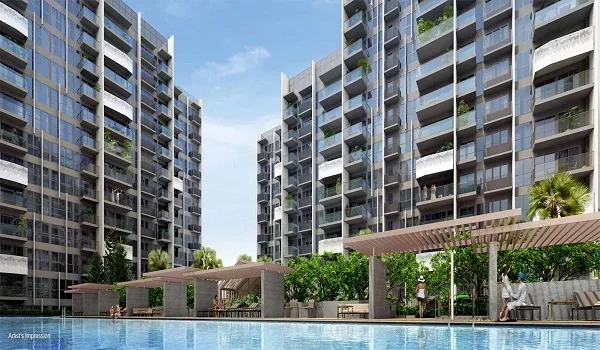
Godrej Regent Park Investment

Godrej Regent Park investment combines three things that drive strong returns in south-Bangalore real estate. Limited boutique inventory in a high-demand sub-market. Walking-distance metro access. An early launch entry rate in a corridor that has delivered 10–15% year-on-year appreciation. This page lays out the investment case. It covers the capital appreciation drivers, the rental yield outlook, and why the 2026 entry window matters.
Headline Investment Numbers
| Metric | Value / Range |
| Launch entry rate | ₹12,000+ / sq.ft. |
| Indicative all-in cost (2 BHK) | ~₹1.73 Crores |
| Indicative all-in cost (3 BHK 3T Luxe) | ~₹2.60 Crores |
| Catchment 5-yr historical appreciation | 10–15% YoY (~50–60% cumulative) |
| Catchment gross rental yield | 3.5% – 5.5% |
| Projected 2031 3 BHK 3T Luxe resale value | ~₹3.56 Cr+ (indicative) |
| Hold horizon (launch to handover) | 5 years (2026 to Aug 2031) |
| Indicative CAGR through handover | ~6.5% |
Indicative projections only. Actual returns depend on market conditions, individual unit characteristics and exit timing.
Three Capital-Appreciation Drivers
1. Boutique Inventory in a High-Density Catchment
Most upscale south-Bangalore launches push 600–1,200-unit inventory to maximise FSI. Godrej Regent Park deliberately caps at 500 units across 2 towers. Tighter inventory creates two return tailwinds. First, less comparable resale supply once handover happens. That supports price discipline. Second, a "boutique premium" that resale buyers tend to pay over equivalent mass-format projects.
2. Metro-Walkable Address
Upcoming Sarjapur Road Metro Station (DPR stage) sits ~1–2 km from the project gate. That is a short ~1–2 km drive. Walking-distance metro proximity is one of the most durable real-estate value drivers. It doesn't decay the way "upcoming infrastructure" claims sometimes do. Namma Metro Sarjapur–Hebbal Metro Line (Phase 3, DPR stage) is currently under construction (DPR approved 2024, civil works in early phase, phased commissioning expected through 2031-2033). The Namma Metro Phase 3 expansion will extend the network further along the Sarjapur corridor through 2027–2030.
3. Infrastructure Catalysts Through to Handover
- Wipro Sarjapur Campus (~9 km): Creates direct employment demand and supports rentals.
- Namma Metro Phase 3: First lines operational 2027–2030; further extends Sarjapur corridor metro coverage.
- Marathahalli–Outer Ring Road Elevated Expressway: Cuts commute times to central Bangalore, lifting catchment desirability.
- Bangalore Airport Metro (Blue Line): Operational 2027–2028; opens direct metro access to BLR airport via Hebbal.
- Satellite Town Ring Road (STRR): Improves orbital access from east Bangalore to east and west tech corridors.
Return Profile — Worked Examples
Scenario A — 3 BHK 3T Luxe Long-Hold (Buy 2026, Hold to 2031)
- Launch all-inclusive entry: ~₹2.60 Crores
- Projected 2031 fair-market resale value: ~₹3.56 Crores
- Total appreciation: ~₹0.96 Cr (37%)
- CAGR: ~6.5%
- Plus rental income post-handover (Aug 2031 onwards): ~₹70,000/month projected
Scenario B — Pre-Possession Resale (Buy 2026, Sell 2029 at 60% Construction)
- Launch all-inclusive entry: ~₹2.60 Crores
- Projected 2029 transfer value: ~₹3.10 Crores
- Total appreciation: ~₹0.50 Cr (~19%)
- CAGR: ~6%
- Note: transfer fee (~₹200–250 per sq.ft.) and stamp duty on the new sale agreement apply
Scenario C — Rental-Income Investor (Buy 2026, Rent from Aug 2031)
- Total acquisition cost (3 BHK 3T Luxe): ~₹2.60 Crores
- Projected monthly rent at handover: ~₹70,000
- Annual rental income: ~₹8,40,000
- Gross yield: ~3.2%
- Net yield (after 25% deductions): ~2.4%
- Plus continued capital appreciation across the holding period
Why the Early Launch Window Matters
Godrej Regent Park launched on 15 July 2026 following Karnataka RERA registration on the same date. The pre-launch EOI window closed at the official launch on 15 July 2026, and bookings now follow the launch price list at ₹12,000+/sq.ft. Based on Godrej Properties's prior south-Bangalore launches, rates typically continue to firm up as construction progresses across the build cycle. Entering early in the launch phase remains the lowest-cost point in the project's lifecycle.
Investor Profile — Who This Works For
- HNI buy-and-hold investors: Patient capital seeking south-Bangalore exposure with a 5–7 year hold horizon.
- NRI buyers: Boutique format plus metro walkability appeals to NRIs looking for a Bangalore second home that resells well.
- Dual-income professional families: Owner-occupiers who also see the 5-year appreciation profile as a secondary benefit.
- Senior corporate professionals: The 3 BHK 3T (Luxe) configuration with staff quarter targets this segment specifically.
Investor Profile — Who This Doesn't Work For
- Short-term flippers looking for 12–18 month exits — yields and appreciation are calibrated for 4+ year hold horizons.
- Buyers seeking ultra-high rental yields (>5% net) — premium-segment yields in east Bangalore typically sit below this threshold.
Risks to Consider
- Early-stage timing: The project is K-RERA registered (PRM/KA/RERA/1251/308/PR/150726/008810, approved 15 July 2026) and is at the start of its build cycle, so returns depend on construction progressing to schedule.
- Construction-period market risk: 5-year build cycle exposes the buyer to one market cycle minimum.
- Sub-market saturation: Multiple boutique launches in the Sarjapur corridor may temporarily soften pricing if launched simultaneously.
- Regulatory risk: Changes in GST rates, stamp duty or RERA rules affect all-inclusive cost calculations.
Frequently Asked Questions about Investment
1. Is Godrej Regent Park a good investment in 2026?
For 5+ year hold horizons, the answer is yes. The case rests on three things. The catchment's 10–15% historical appreciation. The metro-walkable address. The boutique format. Entering at the current launch rate, early in the 2026–2031 build cycle, adds a further entry advantage.
2. What's the expected CAGR?
Indicative CAGR through handover (2026–2031) is approximately 6.5%. This is based on the historical catchment trajectory. Post-handover, rental income layers on. Total annual return rises to ~9%. That is capital plus net yield.
3. How does this compare with Whitefield or Sarjapur investments?
Whitefield and Sarjapur have larger employment-belt rental demand. They tend to have higher inventory and mass-format pricing. Godrej Regent Park's south-Bangalore catchment shows slightly tighter inventory and comparable yields. The boutique format is differentiated. Both markets are sound. The choice depends on investor preferences around employment-belt proximity vs metro walkability.
4. Can I sell before possession?
Yes. Pre-possession transfer of allotment is permitted. A transfer fee of ~₹200–250 per sq.ft. applies. Stamp duty on the new agreement also applies. This is most useful when partial appreciation has occurred but the buyer wants liquidity before handover.
5. What's the home-loan strategy for investors?
Most investors take 70–80% LTV from the partner-bank panel (HDFC, ICICI, SBI, Axis, etc.). The construction-linked payment structure means EMI ramps up only as drawdowns happen. That keeps early-period interest cost low. Section 80C / Section 24 tax benefits on home-loan interest add a return layer.
6. How are capital gains taxed on resale?
Long-term capital gains (after 24 months of holding) are taxed at 12.5% per prevailing 2026 rules. Indexation benefits are available. Short-term gains (within 24 months) are taxed at the applicable income-tax slab. The 5-year hold horizon at Godrej Regent Park is well clear of the 24-month threshold. LTCG treatment is the default.
Godrej Regent Park Blog